Texas chose to proactively acknowledged defeating Alzheimer’s will require coordinated research efforts, innovation, early intervention, and support for families and caregivers
By Dr. Robin Armstrong
AUSTIN, Texas (Texas Insider Report) — Alzheimer’s disease is one of the greatest public health challenges facing our country – and for too long it has failed to receive the urgency and coordinated response it demands. In Texas, we have taken an important step toward changing that.
 During the 89th Texas Legislative Session, lawmakers advanced Senate Bill 5 establishing the Dementia Prevention & Research Institute of Texas. This legislation reflects an important recognition by our state: dementia and Alzheimer’s disease are not simply healthcare issues. They are family crises, economic threats, and growing challenges that demand bold leadership.
As a physician who cares for patients in skilled nursing homes across Houston and Galveston, I see the toll of Alzheimer’s and dementia every day. I see it in patients who lose the independence they once cherished. I see it in families struggling to make difficult care decisions. I see it in caregivers who are exhausted, heartbroken, and often unsure where to turn next.
Behind every diagnosis is usually an entire network of loved ones carrying enormous emotional, physical, and financial burdens.
Spouses become full-time caregivers. Adult children rearrange careers and family responsibilities to care for aging parents. Families exhaust retirement savings paying for long-term care while coping with the heartbreak of watching someone they love slowly lose memory, independence, and dignity.
These caregivers are the invisible backbone of Alzheimer’s care in America, yet too often their sacrifices go unrecognized.
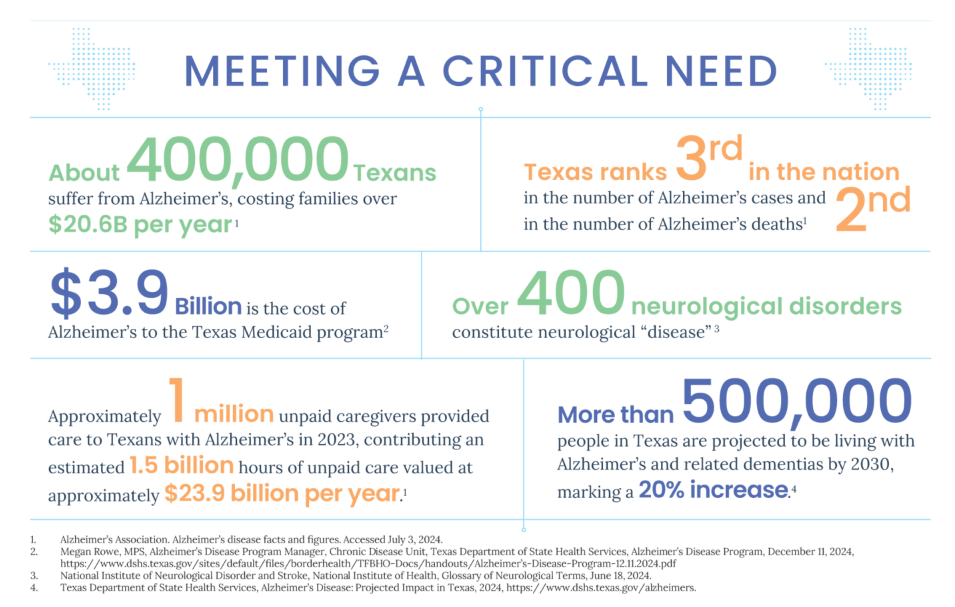
Today, more than seven million Americans are living with Alzheimer’s disease, and without major medical breakthroughs, that number is expected to nearly double by 2060.
Alzheimer’s is already one of the leading causes of death in the United States and remains among the most devastating diseases for patients, families, and long-term care providers.
The financial consequences are equally staggering. Alzheimer’s disease and related dementias place enormous strain on families, healthcare systems, Medicare, Medicaid, and the long-term care system that so many vulnerable patients depend on.
 Doing nothing is no longer an option.
That is why Texas’ action matters.
By creating the Dementia Prevention and Research Institute of Texas, our state has committed itself to advancing research, innovation, prevention, early diagnosis, and treatment for dementia-related illnesses, including Alzheimer’s disease, which accounts for the majority of dementia cases nationwide.
Texas recognized that the fight against dementia begins with confronting Alzheimer’s disease directly.
This action also comes at a moment when science is creating real hope for patients and families.
Researchers have made remarkable advances in understanding Alzheimer’s disease over the past decade. New therapies designed to target amyloid plaques in the brain are showing promise in slowing cognitive decline for some patients with early-stage Alzheimer’s. Blood-based diagnostic tests are making earlier detection more accessible.
Growing evidence also points to the importance of cardiovascular health, exercise, sleep, and metabolic health in reducing dementia risk.
For families facing Alzheimer’s, these breakthroughs matter enormously.
Early diagnosis and treatment can give patients more time to remain independent, participate in family life, and make important decisions about their future. It also gives caregivers time to prepare and adapt before the disease reaches its most devastating stages.
But despite scientific progress, too many Americans still face unnecessary barriers to testing, treatment, and specialized care. Access remains uneven. Insurance restrictions can delay care. Research funding still falls short of the scale of the challenge.
That is why Texas’ example matters nationally.
SB 5 demonstrates what serious leadership looks like. Rather than waiting for the crisis to worsen, Texas chose to invest proactively in solutions. Our state acknowledged that defeating Alzheimer’s disease will require coordinated research efforts, innovation, early intervention, and support for families and caregivers.
Washington should take note.
America has historically responded boldly to major public health threats – from Cancer Research to Heart Disease Prevention. Alzheimer’s disease deserves the same level of national commitment and urgency.
A strong national Alzheimer’s initiative modeled after Texas’ leadership could accelerate research, expand access to early diagnosis, support caregivers, and help bring life-changing treatments to more Americans. It would also strengthen our healthcare system and help reduce the enormous long-term financial burden dementia places on taxpayers and families alike.
Most importantly, it would offer hope.
Hope for patients who want more time with their families.
Hope for caregivers who feel overwhelmed and unseen.
Hope for future generations who deserve a world where Alzheimer’s no longer devastates millions of American families.
Hope for caregivers who feel overwhelmed and unseen.
Hope for future generations who deserve a world where Alzheimer’s no longer devastates millions of American families.
Texas has stepped forward and shown what leadership looks like. Now the rest of the country should follow.
 Dr. Robin Armstrong, M.D., is a Galveston County, Texas, County Commissioner who practices medicine in his hometown of League City. He is an owner of the Armstrong Medical Group, a group of hospital & nursing home physicians, nurse practitioners, and physician assistants, and serves as the National Committeeman to the Republican National Committee for the State of Texas.