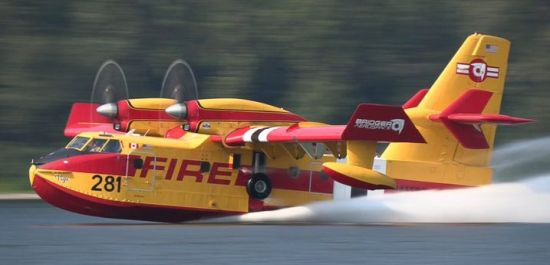
AUSTIN, Texas (Texas Insider Report) — If you’ve been anywhere near a wildfire in Texas this year, chances are you’ve seen giant yellow and red planes overhead dropping water from the sky. The planes are Bridger Aerospace "Super Scoopers," and what they are capable of is hard to believe.
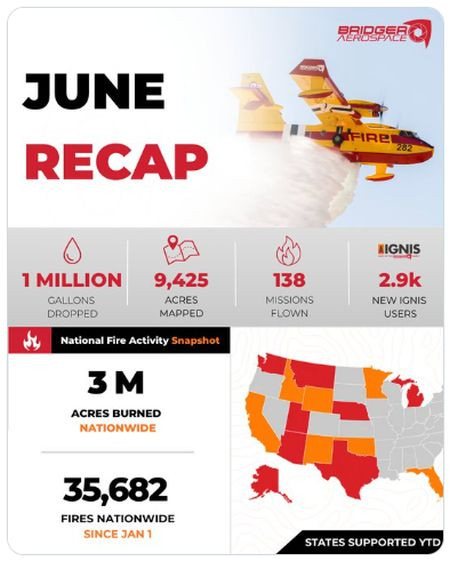 The Bridger Super Scoopers – yes – literally scoop water from nearby water sources and drop it on wildfires. And, the planes have spent 36 days working in Texas so far this year, logging more than 80 flight hours and dropping more than 130,000 gallons of water on fires in Texas.
As wildfire seasons grow longer and more destructive across the United States, aerospace technology companies are racing to provide firefighters with better information on the fire line, and Bridger Aerospace believes its newest software platform could help reshape how those decisions are made.
Bridger recently introduced Ignis, a fire intelligence platform designed specifically for wildland firefighters. According to the company, the platform combines live mapping, real time operational data and offline communication tools into a single operating picture intended to improve firefighter safety and coordination during active incidents.
Back in May, Bridger’s multi-mission aircraft worked in the state, notably mapping the Yellow Fire in the Texas Panhandle and live streaming the intelligence both to the incident commander on the ground and back to College Station to the Texas A&M Forest Service.
Thanks to the data from Ignis that showed the fire had crossed a road, the incident commander was able to redirect resources quickly and save an entire neighborhood.
Thanks to the data from Ignis that showed the fire had crossed a road, the incident commander was able to redirect resources quickly and save an entire neighborhood.
Ignis represents the company's latest effort to expand beyond aerial firefighting into technology that supports incident commanders and crews on the ground.
"Firefighters have long relied on disconnected software and static PDF maps," Bridger Aerospace said in a statement announcing the platform.
The company said Ignis replaces those materials with continuously updated digital maps that can be modified by personnel actively managing an incident.
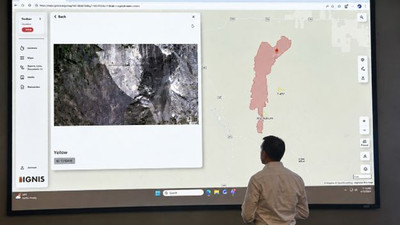 The platform includes dynamic mapping capabilities, real time data tools and communication features designed to continue functioning even when internet connectivity is limited, a common challenge in remote wildfire environments.
The company said Ignis replaces those materials with continuously updated digital maps that can be modified by personnel actively managing an incident.
The platform includes dynamic mapping capabilities, real time data tools and communication features designed to continue functioning even when internet connectivity is limited, a common challenge in remote wildfire environments.Bridger Aerospace livestreamed data from the Yellow Fire in Hartley County, Texas back to College Station for review by Texas A&M's Forest Service through its Ignis platform in May, 2026
Wildfire management has increasingly become a technology-driven operation. Fire agencies today rely on satellite imagery, drones, infrared sensors, aircraft tracking and predictive modeling to understand rapidly changing fire behavior. Those tools often come from different software providers, requiring firefighters to move between multiple systems while responding to fast-moving incidents.
Industry experts have increasingly emphasized the value of integrating those data sources into a common operating picture that can be shared among incident commanders, aviation resources and firefighters working on the ground.
As wildfire activity continues to place growing demands on emergency response agencies, Bridger Aerospace's CEO, Sam Davis, said the company is focused on equipping frontline firefighters with technology that improves situational awareness during rapidly evolving incidents.
Larger fire seasons, expanding development in fire-prone areas and increasingly complex incidents have led governments to invest more heavily in technologies that can improve coordination while reducing risk to firefighters.
Companies throughout the wildfire technology sector have introduced digital mapping systems, artificial intelligence tools and advanced analytics in recent years. Bridger Aerospace argues Ignis distinguishes itself by offering a platform purpose-built for firefighters rather than adapting general mapping software for emergency response.
Companies throughout the wildfire technology sector have introduced digital mapping systems, artificial intelligence tools and advanced analytics in recent years. Bridger Aerospace argues Ignis distinguishes itself by offering a platform purpose-built for firefighters rather than adapting general mapping software for emergency response.
Whether platforms like Ignis become standard tools across fire agencies will depend on adoption by Federal, State & Local organizations, many of which are seeking ways to improve interoperability while giving crews access to current information in rapidly changing conditions.
For Bridger, the launch of Ignis reflects a broader strategy of pairing aerial firefighting assets with software designed to support decision making throughout the life cycle of a wildfire.
As agencies continue looking for new ways to respond to increasingly challenging fire seasons, integrated intelligence platforms are expected to play an increasingly important role in wildfire operations.