By Yaakov Menken
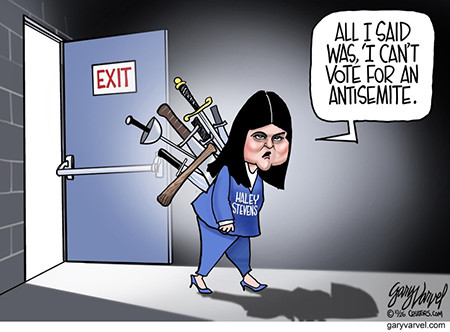
On Sunday, Rep. Haley Stevens announced that she could not support her party's nominee for the U.S. Senate, Dr. Abdul El-Sayed, after he refused to meet even the most minimal standard for opposing antisemitism. Her party's response was to call her self-centered. That tells us far less about Stevens than about the state of the Democrat Party.
Stevens's explanation was brief and, needless to say, accurate: "Because when you see hate, when you see us standing with Hasan Piker... it's not acceptable." That was why, after weeks of soul-searching and rejected efforts to convince El-Sayed to disavow previous antisemitic rhetoric, Stevens switched her endorsement to Republican Mike Rogers at the eleventh hour.
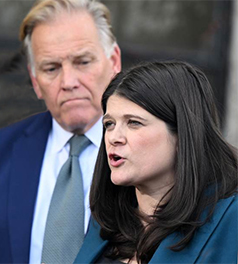 Stevens' also said that "Our Democratic nominee for Senate said I was no longer welcome in his campaign and that I should stay away. And he's right." Within hours, that was used to misrepresent her courage as nothing more than hurt feelings.
Rep. Troy Carter of Louisiana ridiculed her "bruised ego." Senate Minority Leader Chuck Schumer called it a "despicable betrayal." And Sen. Elissa Slotkin said that someone like Stevens should "think hard about whether they are serving the greater good."
Before granting undue credence to the notion that Stevens is merely a sore loser, consider where she stood long before she lost anything.
In May of last year, the House Committee on Education and the Workforce held a hearing on antisemitism at colleges beyond the Ivy League. Republican members pressed the presidents of Haverford, DePaul and Cal Poly to explain their responses, or lack thereof, as Jewish students were harassed and assaulted. Their Democratic colleagues, on the other hand, used their time to complain about "performative hearings," and imply that such a hearing was useless or even counterproductive. Rep. Ilhan Omar called the hearing an attack on "protected speech." Rep. Greg Casar claimed Republicans were politicizing antisemitism, and went on to call President Trump "the most antisemitic president in modern American history."
Only one Democrat on the committee treated the subject with the severity it so clearly deserved: Haley Stevens. She said antisemitism was "exploding" and insisted it be treated as a nonpartisan issue. She rebuked her colleagues for dismissing the committee's work as a "false obsession." On whether anti-Zionism is something other than antisemitism, she observed that "We haven't yet really seen that exist." As my colleague Kayla Gubov and I wrote at the time, she was objectively correct, and she was alone.
Look, too, at what she asked of Abdul El-Sayed. She did not ask him to change his foreign policy views, but to condemn an outlook that blames Israel for the price of eggs in Detroit — an outlook clearly on loan from 1930s Germany. She asked him to apologize for his past rhetoric about Israel, and to remove a clip of Tucker Carlson from his campaign materials. "Abdul promises to get money out of politics," she wrote. "He can begin by getting Israel out of his explanation for everything Michigan cannot afford."
That is a remarkably low bar to clear. It is the least that a Jewish voter in Michigan, or any American who remembers what happens when a minority is blamed for the cost of bread, should expect from someone seeking a Senate seat. El-Sayed's answer was "None of this matters," followed by a request that she stay away from his remaining events.
Neither was Stevens the only Democrat to see and address the problem. For months, Michigan Jewish leaders, including many who share El-Sayed's leftist, progressive views, asked him to sign simple commitments on Jewish safety. They received silence in return.
The day after a terrorist attacked Temple Israel in West Bloomfield on March 12, a synagogue with a preschool, El-Sayed released a video explaining that "hurt people hurt people," implying that Israeli strikes intended to stop murder of children in Northern Israel explained an attack on children in a Michigan synagogue. His "apology" came five and a half months later, after he had won the primary, and was conditional: "If my statement caused pain, I'm sorry."
The problem was no more about hurt feelings then than it is now. He failed to retract his implication that Jewish safety in Michigan depends upon what bigots think of Israel's conduct overseas. That should surprise no one: he has called Israel's operations "genocide," said Israel is "not actually our friend," and campaigned alongside Hasan Piker, who warned that if American Jews keep supporting Israel, "eventually someone's going to come around and take action." Someone already did that, in West Bloomfield, and that was the point.
Rep. Carter's statement allows that "Antisemitism is serious, and we have an obligation to confront it." In the next sentence, he offers that El-Sayed "has said clearly that he disagrees with the contents" of the ad. Carter then asks, "What changed?"
The answer is that nothing changed, and that is precisely the point. For El-Sayed to claim that he disagrees with the "contents" of one particular ad is not a repudiation of its toxic and hateful worldview. On the contrary, as Stevens said, the ad "did not invent its argument;” it is one that "Dr. El-Sayed has made in his own words throughout this campaign."
The Haley Stevens who stood alone at that hearing in 2025 is the same Haley Stevens who stood alone on November 1. What changed was the request: she was asked to lend her name and her reputation to a candidate who has repeatedly refused her entreaties, and those of others, that he do the minimum. She declined because he had declined.
The Mishnah in Pirkei Avos (2:5) teaches, "In a place where there are no men, strive to be a man." It does not promise that the one who stands up will be thanked. Stevens knew that her statement would cost her friendships, staff, and potentially a political future. For her to say it anyway took both a moral compass and a moral backbone.
Who represents Michigan in the Senate is for Michigan's voters to decide, and they will do so on Tuesday. But every American, Democrat or Republican, should be asking a different question, one that will outlast this election: when the only member of a party willing to treat antisemitism as an emergency is told to stay away, and is then called selfish for leaving, what does that party truly stand for?