The Welcome Demise of Climate Change Catastrophism
- by:
- 2025-12-05
- Source:
texasinsider

- 12/05/2025

columnist Josh Hammer by is licensed under
By Josh Hammer
Is the American Left finally waking up from its decades-long climate catastrophism stupor? For years, climate alarmism has reigned as political catechism: The planet is burning, and only drastic action -- deindustrialization, draconian regulation, even ceasing childbearing -- could forestall a certain apocalypse. Now, at least some signs are emerging that both the broader public and leading liberal voices may be recoiling from the doom and gloom.
First, recent polling shows that the intensity of climate dread is weakening. According to a July 2025 report from the Yale Program on Climate Change Communication, while a majority (69 percent) of Americans still say global warming is happening, only 60 percent say it's "mostly human-caused"; 28 percent attribute it mostly to natural environmental changes. A similar October 2025 study from the University of Chicago's Energy Policy Institute found that "belief in human-driven climate change declined overall" since 2017. Interestingly, Democrats and political independents, not Republicans, were primarily responsible for the decline.
Moreover, public willingness to countenance personal sacrifice in the name of saving the planet seems to be plummeting: An earlier October 2024 poll from the Pew Research Center found that only 45 percent said human activity contributes "a great deal" to climate change. Another 29 percent said it contributes "some" -- while a quarter said human influence was minimal or nonexistent.
The moral panic is slowly evaporating. Millions of Americans may still believe warming exists, but far fewer view it as an imminent existential threat -- let alone embrace sweeping upheavals in energy policy and personal lifestyle.
The fading consensus among ordinary Americans matches a more dramatic signal from ruling class elites. On Oct. 28, no less an erstwhile ardent climate change evangelist than Bill Gates published a remarkable blog post addressing climate leaders at the then-upcoming COP30 summit. Gates unloaded a blistering critique of what he called "the doomsday view of climate change," which he said is simply "wrong." While acknowledging the serious risks for the poorest countries, Gates insisted that humanity will continue to "live and thrive in most places on Earth for the foreseeable future." He added that "using more energy is a good thing, because it's so closely correlated with economic growth." One might be forgiven for suffering a bit of whiplash.
The unraveling of climate catastrophism got another jolt recently with the formal retraction of a high-profile 2024 study published in the journal Nature. That study -- which had predicted a calamitous 62 percent decline in global economic output by 2100 if carbon emissions were not sufficiently reduced -- was widely cited by transnational bodies and progressive political activists alike as justification for the pursuit of aggressive decarbonization. But the authors withdrew the paper after peer reviewers discovered that flawed data had skewed the result. Without that data, the projected decline in output collapses dramatically to around 23 percent. Oops.
The climate alarm machine -- powered by the twin engines of moral panic and groupthink homogeneity -- is sputtering. When the public grows skeptical, when billionaire techno-philanthropists question the prevailing consensus, and when supposedly mainstream scientific projections reverse course, that's a sign that the days of Al Gore's "An Inconvenient Truth" propaganda documentary and John Kerry's "special presidential envoy for climate" globe-trotting vanity gig are officially ove
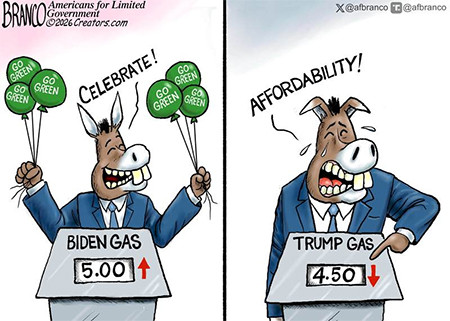
Ultimately, no one stands to benefit more from this incipient trend toward climate sanity than the American people themselves. In an era where optimism can be hard to come by, the professed certitude of imminent environmental apocalypse is pretty much the least helpful thing imaginable. If one is seeking to plant the seeds of hope, nothing could be worse than lecturing to the masses that one is a climate change-denying" misanthrope if he has the temerity to take his family on an airplane for a nice vacation or -- egad! -- entertain thoughts of having more children. Even more to the point, given the overwhelming evidence that Americans are now primarily concerned about affordability and the cost of living, more -- not less -- hydrocarbon extraction has never been more necessary.
There are green shoots that liberals and elites may be slowly -- perhaps grudgingly -- giving up on the climate catastrophism hoax to which they have long stubbornly clung. In America's gladiatorial two-party system, that could well deprive Republicans of a winning political issue with which to batter out-of-touch, climate change-besotted Democrats. But for the sake of good governance, sound public policy and the prosperity of the median American citizen, it would be the best thing to happen in a decade.
columnist Josh Hammer by is licensed under