They’re Not Just Losing—They’re Collapsing
- by:
- 03/25/2026
- Source:
texasinsider

- 03/25/2026

Columnist Kevin McCullough by is licensed under
By Kevin McCullough
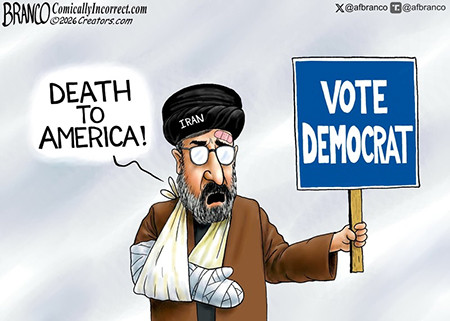
If you want to understand what’s really happening in Iran right now, don’t listen to the spin. Watch the behavior. Watch who’s being expelled. Watch who’s being deployed. Watch who’s suddenly willing to talk. Because when you line up the facts—not the narratives—you see something unmistakable: This isn’t a stalemate. This is a regime in collapse.
Let’s start with the battlefield reality.
According to U.S. leadership, Iran’s military—long hyped as a regional powerhouse—has been dismantled at a pace that even seasoned observers didn’t expect. War Secretary Pete Hegseth didn’t mince words, describing the campaign as historically decisive, noting that a “modern military” had been “rapidly… obliterated” from the outset.
That’s not rhetoric. That’s results.
We’re talking about thousands of targets struck, critical infrastructure neutralized, naval assets destroyed, and the regime’s ability to project force across the region dramatically reduced.
And here’s the part that the critics—remember them? “Forever war!” “Quagmire!”—still can’t process: The speed matters. Because speed equals shock. And shock breaks regimes.
Now layer on top of that what’s happening diplomatically.
Lebanon just told Iran’s ambassador to pack his bags and leave. Saudi Arabia followed suit, expelling Iranian officials and severing one of the last functioning diplomatic channels. That’s not coincidence. That’s isolation. And isolation is the death spiral of any regime that survives on projection, intimidation, and proxy influence.
For decades, Iran’s power wasn’t just about missiles or drones. It was about networks—Hezbollah, regional proxies, back-channel diplomacy, intimidation through presence. Now? Those networks are fraying. Countries that once tolerated Iran are now publicly rejecting it. And they’re doing it after the United States and Israel demonstrated overwhelming force. That’s not diplomacy in a vacuum. That’s diplomacy responding to reality.
Meanwhile, on the military front, the United States is sending a very different kind of message—one that should make every armchair critic from the last three weeks sit down and take notes.
Three thousand elite paratroopers from the 82nd Airborne are being deployed to the region. Not because we’re escalating into a forever war. But because we’re locking in the endgame. That’s what real strategy looks like.
You apply overwhelming force. You collapse your enemy’s capacity to resist. And then you position strength to ensure the outcome sticks.
This isn’t Iraq. This isn’t Afghanistan. This is something entirely different. And it’s driving the critics absolutely crazy. Because they built an entire narrative around inevitability.
They told you this would drag on for years. They told you this would spiral out of control. They told you America had no exit strategy. And instead? We have a regime losing allies, losing leverage, and—this is key—losing internal coherence.
Which brings us to the most important question nobody on the Left seems willing to ask: Who is actually running Iran right now?
Because the answer is… complicated.
Top leadership has been decimated or driven underground. Power is fractured between remnants of the Revolutionary Guard, surviving political figures, and whatever shadow structure is trying to hold things together behind the scenes.
That’s not stability. That’s a power vacuum. And power vacuums don’t negotiate from strength. They negotiate from desperation. Which explains why, despite public denials, multiple channels of communication are now reportedly open between the U.S. and “the right people” inside Iran.
Read that carefully.
Not official people. Not public people. The right people. That’s how regime transitions happen. Quietly at first. Behind the scenes. While the public face pretends everything is fine. But nothing is fine.
Not when your military has been dismantled. Not when your diplomats are being expelled. Not when your economy is choking on a disrupted Strait of Hormuz, and global pressure is mounting. Not when your enemies are flying overhead uncontested. And certainly not when the United States is both negotiating and positioning troops simultaneously.
That combination—force plus diplomacy—is not a contradiction. It’s the formula. It’s how wars end. And it’s exactly what the critics said couldn’t happen.
Let’s be blunt. The same voices that mocked the idea of decisive victory are now scrambling to explain why everything is moving so fast. They don’t have a framework for it. Because their framework assumes American power is inherently destabilizing. But what we’re watching right now proves the opposite. American power—used decisively, unapologetically, and strategically—creates clarity. It forces choices. It accelerates outcomes. And in this case, it is exposing something that should have been obvious all along: Iran’s regime was never as strong as it pretended to be.
It was propped up by fear. By proxies. By the assumption that no one would ever challenge it directly.
That assumption is gone now. And with it, the illusion. Which brings us to the emotional truth at the center of all of this.
Columnist Kevin McCullough by is licensed under