Trump Admin took a bold, but important step in December
By Massey Villarreal
AUSTIN, Texas (Texas Insider Report) — AI has been radically reshaping the future of entire industries, including health care, energy and financial services. Seemingly everyone is either using AI or talking about it, as it fundamentally transforms our daily life.
With the dramatic rise of AI, we have also seen a rapid increase in legislation filed at both the state and federal level to regulate this technology.
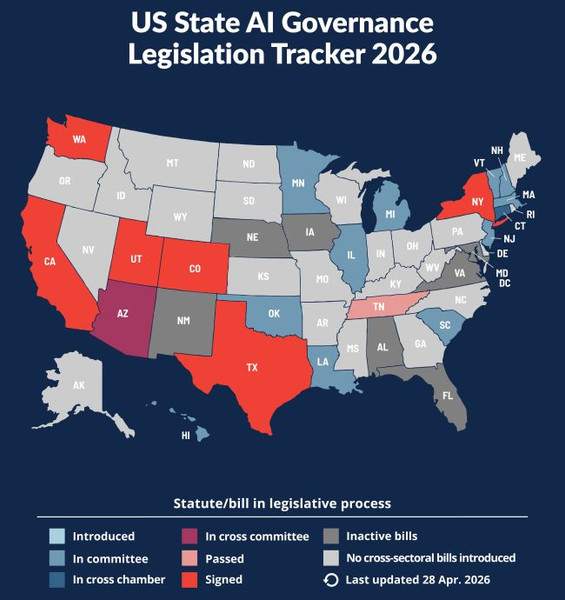 As of March of this year, governments in all 50 U.S. states, Puerto Rico, the Virgin Islands and Washington, D.C. have either introduced, adopted or enacted more than 1,500 new measures regulating how AI can be used and developed — governing everything from content generation, transparency, companies’ risk management practices and even human resources.
But as new AI tools emerge, evolve and increasingly integrate into our everyday lives, companies that both develop and use AI applications are navigating a complex patchwork of varying and often contradictory regulations.
With the speed at which AI is changing how companies large and small manage their day-to-day operations, many of these regulations quickly become outdated and obsolete just as they are being implemented, since free market forces propel AI developers to adapt quickly to consumer preferences and industry priorities.
Here in Texas, we took a measured approach to avoid stifling innovation enacting a new AI law last session that reinforced existing consumer protections surrounding things like discrimination and criminal activity while federal lawmakers work toward a more comprehensive solution.
Understanding the consequences of having 50 (or more) different state-level laws governing how, where, and to what degree AI can be used, the Trump Administration took a bold but important step in December by issuing a landmark executive order establishing a national policy framework for AI regulation and this March released a detailed legislative plan on what this national framework entails.
The president’s framework helps forestall a fractured regulatory landscape that burdens businesses, stifles innovation and creates needless regulatory complexity that ultimately harms consumers and entrepreneurs alike, putting us squarely behind our top geopolitical adversaries like China in the global race for AI dominance.
To be clear: the Executive Order and framework do not mean that America is set to become the ‘Wild, Wild West’ for AI, where guardrails are obliterated and anything goes.
On the contrary, the White House makes certain that its priority is to check “onerous and excessive” state-level regulations governing AI, and that a national, standardized framework must still “ensure that children are protected, censorship is prevented, copyrights are respected and communities are safeguarded.”
Despite the best of intentions, most overzealous state-level AI regulations almost always have the same effect: erecting arbitrary hurdles to small and medium-sized businesses that are using AI to scale and compete at the global level and unlock new access to markets.
A big pitfall that the Trump Administration must avoid is deploying a framework like we have seen in the European Union, which has put in place unreasonably high regulatory barriers for AI companies to access the market while implementing vague definitions of ‘risk’ that create an ever-moving target for companies to hit if they want to roll out a new product or application. The EU’s heavy-handed approach also puts it at a strategic disadvantage in competing with China’s national push for global AI dominance.
All businesses, regardless of whether they are in the AI space, need consistency and predictability to succeed and the Trump administration’s directive the past few months has been clear — Congress should take action on AI.
Rather than implementing fragmented sets of rules to ostensibly ‘protect’ consumers from AI, state lawmakers — including those in the Lone Star State — would be wise to ensure any new regulations work to support, rather than undermine, a national, consistent framework to protect innovation and allow competition in the free market to drive innovation surrounding this critical technology.
 Massey Villarreal is CEO & President of Precision Task Group, Inc., (PTG) in Houston, Texas, recently served as Chairman of the Board for the Texas Association of Business (TAB,) and is a member of the Board of the Greater Houston Partnership (GHP). Villarreal was named by Newsmax as one of the 50 Most Influential Latino Republicans in the nation.